.png)

Employer of Record (EOR) vs. ApS in Denmark
Cost, Risk, and when each option actually makes sense (2026 Guide)
Foreign companies expanding to Denmark usually face the same first decision: Should we hire via an Employer of Record (EOR), or should we set up a Danish ApS?
There is no universal “best” option. The right choice depends on your timeline, risk tolerance, headcount, and long-term intent. This guide explains the real differences in cost, legal exposure, and operational control in 2026.
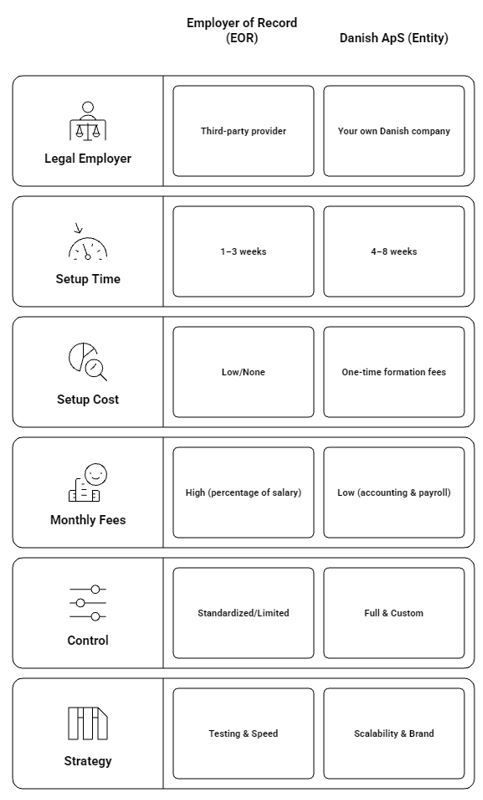
Core difference at a glance
Cost comparison: The Tipping Point
Employer of Record (EOR) – The "Variable" Model
In 2026, EOR pricing in Denmark typically follows a linear cost model:
- Monthly Fee: DKK 3,500 – DKK 6,500 per employee (or 10–15% of gross salary).
- Security Deposit: Often 1–3 months of total employment cost upfront.
- Annual Cost Example: For a senior developer earning DKK 60,000/month, the EOR fee alone can exceed DKK 75,000 per year.
Danish ApS – The "Fixed" Model
- Minimum Share Capital: DKK 20,000 (Reduced in 2024/25; this capital stays in the company).
- Setup: One-time legal and registration costs.
- Operations: Fixed monthly costs for accounting and payroll (typically much lower than EOR fees once you have 2+ employees).
Verdict: If you plan to hire more than one person or stay longer than 12 months, an ApS is almost always the more cost-effective choice.
Risk & Legal exposure: The "Permanent Establishment" trap
A common misconception is that an EOR removes all tax risk. In 2026, the Danish tax authority (SKAT) is increasingly focused on Permanent Establishment (PE).
EOR Risk Profile
- The "Hidden" PE Risk: If your EOR-hired employee is a senior manager or a salesperson who signs contracts, SKAT may rule that you have a "fixed place of business" in Denmark anyway. This can lead to unexpected corporate tax liabilities despite not having an entity.
- IP Protection: While EOR contracts include IP transfer clauses, the strongest legal protection for your intellectual property in Denmark is a direct contract between your entity and the employee.
ApS Risk Profile
- Full Compliance: You are responsible for the Danish Holiday Act, ATP, and mandatory insurances.
- Structural Transparency: An ApS creates a clear, localized tax profile that satisfies both SKAT and Danish banks.
Speed & Timeline
- EOR: Can be active in 10–14 days. No CVR or MitID required.
- ApS: Expect 4–8 weeks. The bottleneck is no longer the registration itself, but the MitID for foreign directors and the corporate bank account opening process.
Best Practice: "The Bridge Strategy"
Many NordicEstab clients use a hybrid approach to avoid losing talent while waiting for an entity:
- Launch via EOR: Hire your first "must-have" candidate immediately to get them on payroll.
- Form ApS in Parallel: Start the ApS and MitID process on Day 1.
- Novation (The Transfer): Once the ApS is ready and the bank account is active, transfer the employment contract from the EOR to your own ApS.
This gives you the speed of an EOR with the long-term ROI of an ApS.
Final takeaway: Which should you choose?
- Choose EOR if: You are hiring a single person for a "market test" or a project lasting less than 6 months.
- Choose ApS if: You are hiring 2+ people, hiring senior leadership, or viewing Denmark as a long-term strategic hub.
We provide objective cost-benefit analyses for foreign founders. Whether you need an EOR recommendation or a full ApS setup with MitID coordination, we ensure you don't stay on the "expensive" model longer than necessary.

Get in Touch
Based in Copenhagen - Working with international clients across the globe
1711 København V
Client Feedback
Their expertise was invaluable during our expansion.